

We've been in the link building industry for over a decade. Without tools, finding backlink opportunities is essentially impossible - and the tool landscape has shifted significantly in the last 18 months.
This guide is updated for May 2026. A few things have changed since the 2024 version:
- AI-search visibility is now part of link-building tools. Ahrefs launched Brand Radar (March 2025) and Semrush launched its AI Visibility Toolkit and Semrush One bundle (October 2025) - both track citations across ChatGPT, Perplexity, Gemini, and Google AI Overviews. The pages AI engines cite are increasingly the same pages worth getting linked from.
- Respona pivoted from SaaS to managed service. The $399/mo software subscription is gone; it's now a pay-per-placement agency-style offering starting at $100/placement.
- Adobe completed its $1.9B acquisition of Semrush on April 28, 2026 (announced November 2025). Semrush now operates as a wholly-owned Adobe subsidiary, with integrations into Adobe's CX Enterprise suite expected over the next 12-18 months.
- Prices have crept up across the board - BuzzSumo +25%, SE Ranking +30–60%, BuzzStream +25% on legacy tiers. Pitchbox is the exception, with entry pricing dropped about 70% to $165/mo.
Below: the 13 tools we'd actually recommend in 2026, with current pricing.
Please note that we're not affiliated with any of these link-building tools.
Contents
Best Specialized Link Building Tools
Let’s start with the 3 best tools specifically designed for link building.
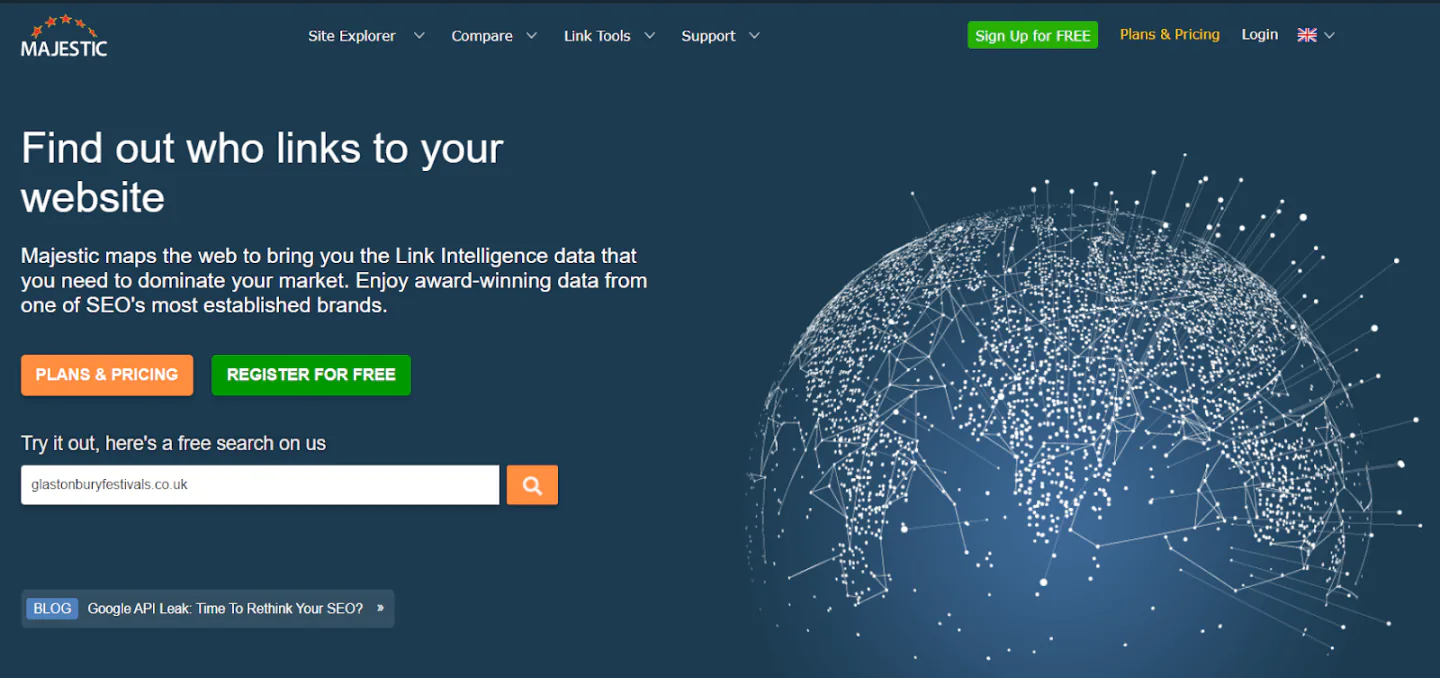
1) Majestic
- Pricing starts at: Free trial. $41.67/mo annually (Lite); $49.99/mo monthly
Majestic comes packed with link analysis tools at one of the most affordable price points in the category. They claim "the most comprehensive link index ever" - which is contested but not crazy.
The most recent independent comparison is Xamsor's 2024 study of 14 backlink tools across 8 controlled domains with known purchased backlinks. The headline finding: Semrush identified the most backlinks in 87% of comparisons, beating Ahrefs, Majestic, and Moz on raw volume. Majestic still came out ahead on link quality signals and historical depth, and Majestic has publicly pushed back on size-based comparisons as misleading - every tool defines a "backlink" slightly differently. So pick based on what you're optimizing for: Semrush if you want maximum coverage, Majestic if you want the most curated index.
Either way, Majestic is one of the most trustworthy link building tools on the market.
Site analysis
Majestic has a suite of tools focused on analyzing backlink profiles. You’ll be able to see a list of all backlinks pointing to a site, new and lost backlinks, different anchor phrases that point to the analyzed website, and other backlink analytics.
One of the most unique tools under this category is the so-called Link Graph, a visual map of the links pointing to a URL. It makes it easier to spot potential issues and discover your own or your competitors’ first, second, third, and fourth tier links.
Comparison, keyword research, and other link analysis tools
Like most link building tools, Majestic, too, has a number of tools that let you discover new keywords and compare your competitors’ backlinks with your own. There’s nothing too special to note here; all the tools do the job well.
One tool that stands out to us, though, is Majestic’s Bulk Backlink Checker. With it, you can simultaneously analyze up to 1,000,000 URLs for their backlink numbers.
Proprietary link metrics
What makes Majestic even more valuable are its several proprietary link metrics (also known as Flow Metrics): Trust Flow, Citation Flow, Visibility Flow, and Topical Trust Flow.
- Trust Flow indicates the quality of links pointing to a site or a URL.
- Citation Flow indicates the number of links pointing to a site.
- Visibility Flow helps you find editorial links - i.e., links that are higher quality than directory-style links.
- Topical Trust Flow indicates the topical relevancy of a page by showing where it’s positioned compared to the best websites.
2) Pitchbox
- Pricing starts at: $165/mo annually (Pro tier); Advanced $420/mo, Scale $675/mo, Enterprise custom
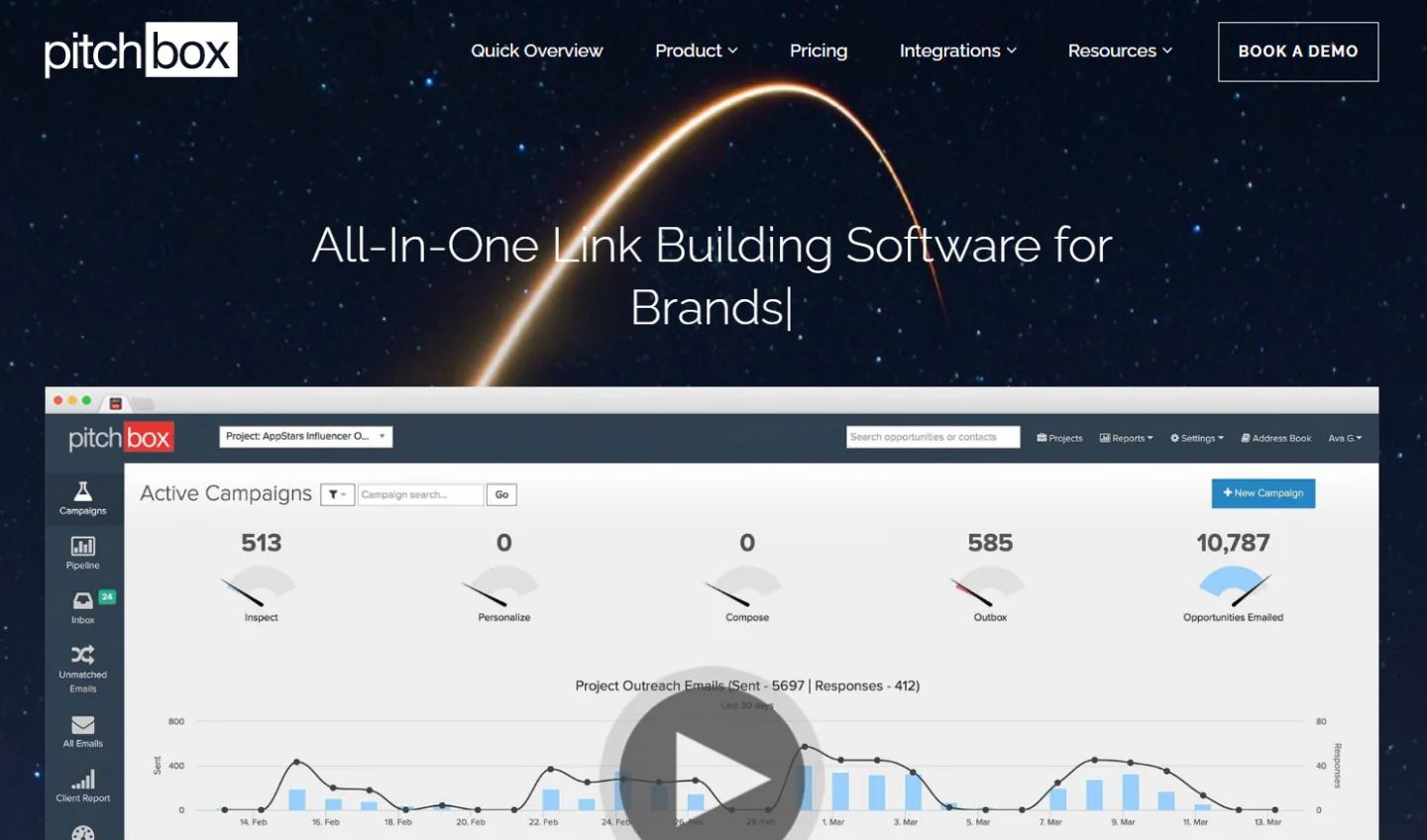
Pitchbox is a link-building software packed with link analysis and management tools, workflow management features, and outreach tools. Unlike Majestic, Pitchbox doesn't just focus on helping you analyze links or find new link building opportunities. It also helps you actually leverage them and build backlinks via outreach.
What's new (2025–2026): Pitchbox restructured pricing and made self-serve plans available - the old $550+/mo enterprise-only entry point is gone. Bulk AI personalization (using prospect-specific context to draft outreach) moved to Advanced+ tiers.
Link analysis and management
Pitchbox has several standard link analysis and management features. For example, you can use it to analyze your own and your competitors’ backlink profiles. If you find toxic backlinks on your site, you can use Pitchbox to disavow them.
You can also monitor your prospects’ websites to identify broken links and replace them with your own.
Influencer outreach
Pitchbox is also a great option for blogger outreach. It lets you use pre-made templates, automate follow-ups, and collaborate with your team. For example, you can assign different prospects to different team members and track the status of your campaigns.
SERP-based prospecting
Finally, Pitchbox can also help you find prospects based on top-ranking search results for your target keyword or topic.
3) Linkody
- Pricing starts at: Free trial. $14.90/mo (Webmaster); Advanced $24.90/mo; Pro $49.90/mo
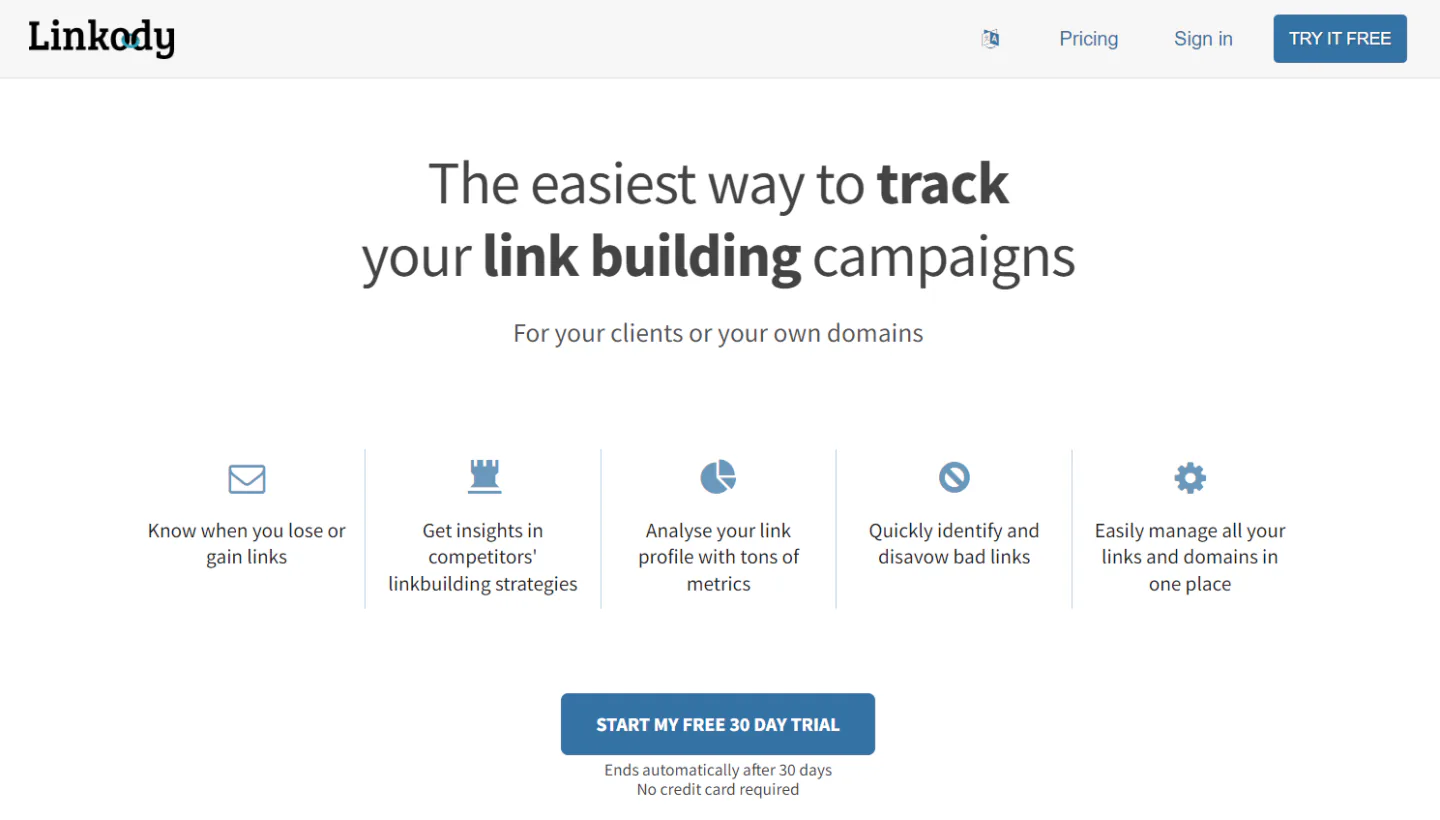
Linkody is one of the cheapest link building tools, but you shouldn’t expect it to have as much data as more robust tools on this list. However, you can integrate it with Ahrefs and Google Analytics to get more reliable reports.
Overall, Linkody is a straightforward link building tool. It may not have the most comprehensive suite of features out there, but we actually like its simplicity. It does the job and doesn’t charge you a fortune for it.
Link management tools
Linkody is one of the few tools that can check if your backlinks are indexed by Google. It also lets you disavow harmful backlinks and run a deep analysis of your backlink profile. Metrics like your top anchors and spam score distribution are shown on intuitive graphs.
24/7 monitoring
Additionally, Linkody monitors your landing pages for 404 errors and your and your competitors’ backlink profiles for any changes. For example, if you lose backlinks or gain new ones, Linkody will automatically send you a report via email.
More Outreach-Oriented Link Building Tools
Now, let’s look at some tools primarily oriented toward building backlinks via outreach. These tools may lack some features you’d get with specialized link building software, such as link analysis and management features.
4) BuzzStream
- Pricing starts at: Free trial. Starter $24/mo; Growth $124/mo; Professional $299/mo (annual saves ~8%)
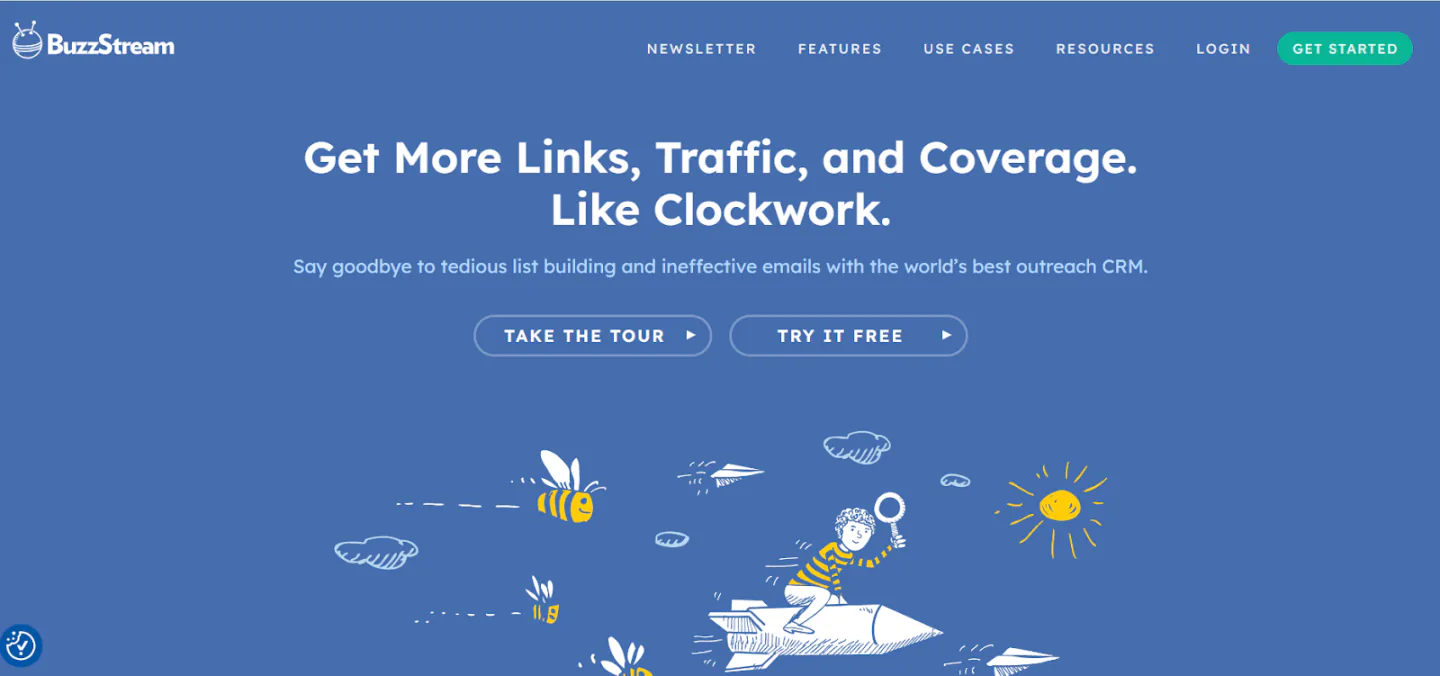
BuzzStream helps you handle your link-building campaigns from start to finish. However, unlike the previous tools on this list, it lacks some more advanced link analysis tools. Still, its affordable pricing and great outreach features make it a great option for those looking to primarily build links through partnerships.
Heads up: Some Capterra reviewers reported a 25% price hike on legacy tiers in 2025 without new features added, so check the current price before committing. BuzzStream also launched ListIQ in 2024–2025, a separate AI-powered media list builder priced $24–$399/mo as its own subscription.
Prospecting
You can find and research your prospects in several ways with BuzzStream. For example, its browser extension, called BuzzMarker, lets you save contacts and even contact them without ever leaving their website. Other options include importing a list of prospects or researching the SERPs within the app.
Email outreach
BuzzStream makes email outreach easier by providing pre-made templates and automation tools. You can also track your team’s performance and the status of different campaigns.
5) Respona
- Pricing starts at: $100/placement (Starter tier, DR 20+); 5 tiers up to $500/placement (Elite, DR 60+). Bulk discounts up to 60% at higher monthly spend.
Respona pivoted in 2025–2026 from a SaaS outreach tool into a primarily managed pay-per-placement service - closer to an agency than a piece of software. The $399/mo software-only tier that used to be its headline plan is gone; today the pitch is "tell us what links you want, we'll do the outreach and pay only for placements that land."
This is a fundamentally different product than what was reviewed in older guides, so be careful comparing to outdated reviews. The underlying tech (content-based prospecting, AI personalization, podcast database, unlinked-mention discovery) still exists, but you're now hiring a team to operate it rather than running it yourself.
For most independent operators, the per-placement model is actually a better fit than the old subscription - you don't pay for months when you don't need links. For agencies building internal outreach capacity at scale, look at Pitchbox or BuzzStream instead.
6) BuzzSumo
- Pricing starts at: Free trial / Content Creation $199/mo annually; PR & Comms $299/mo; Suite $499/mo; Enterprise $999/mo
BuzzSumo is our favorite choice for content marketers who also want to build links via influencer outreach. What it lacks, however, are link analysis and link management tools.
Pricing note: BuzzSumo (still owned by Cision) raised entry-tier pricing meaningfully - what was $159/mo annually in 2024 is now $199/mo for the entry "Content Creation" plan. If you only need it for outreach, BuzzStream at $24/mo is dramatically cheaper.
Contact discovery
BuzzSumo boasts an index of 8 billion articles that can help you identify influencers with high engagement. The dashboard lets you see important engagement metrics, like Pinterest and X (formerly Twitter) shares, at a glance. You can also see exactly who shared your target influencer’s content.
Content discovery and research
As mentioned, BuzzSumo is a great option for content marketers. It facilitates content idea generation by collecting insights on top-ranking content, common questions on forums, and data on viral topics.
With content research features, you can also identify and learn from popular web and social media content. For example, you can get insights into the top-performing content formats or identify your competitors' most popular content.
All-In-One SEO Link Building Tools
Finally, here our top 4 tools that can serve most SEO purposes.
7) Ahrefs
- Pricing starts at: $29/mo (Starter, monthly only) launched Jan 2026; Lite $108/mo annually ($129 monthly); Standard $199-208 annually ($249 monthly); Advanced $374 annually ($449 monthly)
Ahrefs is one of the most comprehensive and reliable SEO tools on the market. It's packed with too many features for us to go into all of them, so here are a few that we consider vital for link-building:
New in 2025–2026: Ahrefs Brand Radar. Released March 2025 and updated in August 2025 (v2.0), Brand Radar tracks how your brand and competitors appear in AI search engines - ChatGPT, Perplexity, Gemini, Microsoft Copilot, plus Google AI Overviews. The August update added Cited Domains and Cited Pages reports (the AI-equivalent of backlink data), and subsequent updates added YouTube (Nov 2025), TikTok, and Reddit tracking (Dec 2025). For link builders, this is meaningful: the domains AI engines cite are increasingly the same targets you want backlinks from. Brand Radar is available across all paid Ahrefs plans, with beta indexes free for Lite+ subscribers; non-beta AI platform indexes cost $199/mo each or $699/mo for the 6-platform bundle on top of your base plan. Ahrefs also launched custom AI prompt tracking in January 2026, letting teams track specific prompts beyond the default search-backed library.
- Backlink Checker - Check your own and your competitors’ backlinks, their domain ratings (DR), and anchor phrases.
- Broken Link Checker - Find broken links on your own or other websites. You’ll also see if any broken links are pointing to your site, so you can notify the webmasters about the issue.
- Link Intersect - Identify all the links linking to your competitors but not to you.
Our favorite feature: Content Explorer
You can use Ahrefs’ Content Explorer for many different use cases. The two that we’ll emphasize are finding guest post opportunities and broken links. Ahrefs shows you both when you enter your target topic.
You can then quickly identify the best opportunities for you by using Ahrefs’ many filters. For example, you can narrow down your search to websites within your chosen domain rating range exclusively.
8) Semrush
- Pricing starts at: Free trial. Pro $117.33/mo annually ($139.95 monthly); Guru $208/mo; Business $417/mo
Semrush is just as comprehensive as Ahrefs, or arguably even more comprehensive. Deciding between the two is not easy and, if we're being honest, there's no particular reason why Semrush comes after Ahrefs on this list.
You won't go wrong with either one.
New in 2025–2026: AI Visibility Toolkit + Semrush One. Semrush launched its AI Visibility Toolkit in 2025 - a direct competitor to Ahrefs Brand Radar that tracks brand citations in ChatGPT, Gemini, Perplexity, Google AI Overviews, and Google AI Mode. It's available as a $99/mo add-on or bundled into the new Semrush One flagship tier (October 2025, $199 Starter / $299 Pro+ / $549 Advanced), which combines traditional SEO + AI visibility tracking. Worth considering if AI search is a meaningful share of your target traffic.
Industry note: Adobe completed its $1.9B acquisition of Semrush on April 28, 2026 (announced November 2025). Semrush now operates as an Adobe subsidiary, with planned integrations into Adobe LLM Optimizer, Brand Concierge, Experience Manager, and Commerce. No customer-facing product changes have shipped yet, but expect deeper Adobe stack integration over the next 12-18 months.
Just like Ahrefs, Semrush comes packed with a wide array of different SEO and content marketing features. We’ll mention only three that may be especially important for link building:
- Backlink Gap Tool - This link-building tool lets you compare the backlink profiles of up to five websites. If you compare your competitors’ profiles with your own, you’ll find sites linking to them but not you. On top of that, you can pinpoint sites linking to all your competitors or just one, depending on which option you choose (Best VS Unique backlinks).
- Backlink Audit Tool - This tool helps you check the health of your backlink profile. Its main purpose is to help you find and disavow toxic backlinks more easily.
- Outreach tools - Semrush also has outreach tools that let you email your prospects, create and save custom email templates, and collect contact information on your prospects.
Our favorite feature: Link Building Tool
Semrush Link Building Tool helps you build links and manage your link-building campaign. It analyzes your competitors to find suitable link-building opportunities. You can add up to 10.
Just like Ahrefs, Semrush makes it easy to narrow down the list of potential sites to ideal candidates. It shows you each site’s domain health and estimated traffic.
Once you start working on building links on these domains, you can update the status to “In progress” and see all your active campaigns at a glance.
9) Moz Pro
- Pricing starts at: Free trial. Starter $39/mo annually ($49 monthly); Standard $79/$99; Medium $143/$179; Large $239/$299
Moz Pro is still actively developed under Ziff Davis (which acquired Moz back in June 2021 via its iContact subsidiary - contrary to occasionally-circulated rumors, Moz was not acquired by Semrush). 2025 brought a meaningful product refresh: a new 4-tier plan structure, integrated Moz AI features across all tiers, an "AI Overviews by Keyword" report, a refreshed Brand Authority Score, and a generous 30-day free trial - one of the longest in the category.
Again, we can’t go into all of those features here. So, we’ll mention just a few we use the most:
- Link intersect - Identify sites that link to your competitors but not you.
- True competitor - Find your true competitors in seconds. This feature is extremely useful if you’re just getting started and have no idea who your competitors are.
- Discovered and lost linking domains - Pinpoint sites that have recently started or stopped linking to you, so you can track the success of your link-building campaigns more easily.
FYI, Moz is not a free link-building tool, but you can use some of its features for free (as long as you don’t exceed the monthly limit).
Our favorite feature: Spam Score
Moz Spam Score tool lets you quickly assess a site’s quality. The spam scores range from low to high, and indicate how likely it is for Google to ban or penalize your target sites:
- Low Spam Score = 1% - 30%
- Medium Spam Score = 31% - 60%
- High Spam Score = 61% - 100%
Moz calculates this score by cross-referencing common features of websites that have already been banned or penalized.
10) SE Ranking
- Pricing starts at: Free trial. Core $103/mo annually ($129 monthly); Growth $223/mo annually ($279 monthly); Enterprise custom
SE Ranking used to be the most affordable all-in-one SEO tool on this list, and it's still cheaper than Ahrefs or Semrush - but the value gap has narrowed. SE Ranking restructured plans in late 2025, replacing legacy Essential/Pro/Business with Core and Growth tiers, and overall pricing has risen roughly 30–60% from where it sat in 2024. Still worth considering if you need rank tracking + audit + competitor analysis in one place at a moderate budget, but no longer the obvious value pick.
It is obviously equipped with a ton of features, so we’ll only mention a few we particularly like:
- Rank tracker - Get data on your keyword positions, track competitors’ keywords, prevent cannibalization, and more.
- Website audit - Get a thorough report on your site’s health and learn how to improve it.
- Competitor analysis tool - Analyze your competitors’ paid and organic campaigns, their keywords, domain authority, and other important metrics.
Our favorite feature: Backlink gap analysis
Like most previous tools we’ve mentioned, SE Ranking also helps you identify sites that link to your competitors and not to you. You can add up to 5 competitors and get quick insights about their backlinks, such as whether they’re dofollow or nofollow and when they were first noticed.
AI-Native Outreach (New for 2026)
The newest category of link-building-adjacent tools is AI-native outreach platforms - software built around large language models and AI agents that handle prospect research, enrichment, and personalization. They're not pure link-building tools, but they're increasingly used for it, especially at scale.
11) Clay
- Pricing starts at: Free tier; Launch $185/mo ($167 annual); Growth $495/mo ($446 annual); Enterprise custom (Clay restructured pricing March 2026, retiring the old Starter/Explorer/Pro tiers)
Clay emerged in 2024–2025 as the dominant AI-native outreach automation tool. It connects 150+ data providers and uses Claygent - an AI research agent - to enrich each prospect with custom research (their recent posts, their company's funding stage, what they wrote about last week, etc.) and then draft genuinely personalized outreach openers at scale.
For link builders, Clay's strength is the enrichment-plus-personalization combo: you can pull a list of 500 prospects, automatically research each one's recent published content, and have Claygent draft a reference-specific opening line for each - work that would take a human researcher days. The output still needs human review before sending, but the ratio of useful prospects per hour goes up dramatically.
Clay isn't a sending platform; you pipe its output into BuzzStream, Pitchbox, Lemlist, or whatever you already use for the actual email send.
Bonus Link Building Tools
Most link building tools come with a hefty price tag. Although there's no real way to replace them with anything that's free, there are some free "tools" that can help you get started with link building.
12) Google Search Operators
- Free
Looking for a cheap but effective way to find link-building opportunities? Use Google Search Operators (GSO).
Search operators are special characters and sequences you can add to your query to get targeted search results.
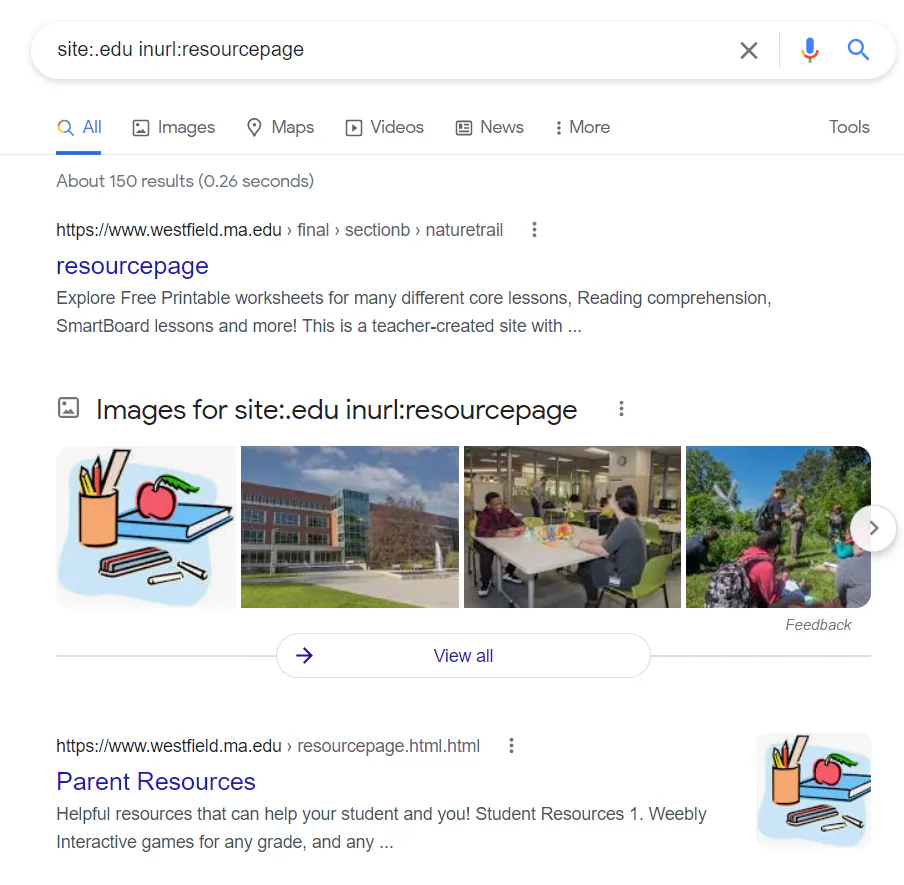
We talked about this more in our article on getting .edu backlinks. There, we suggested using commands like these to find .edu sites that could host your links:
- site:.edu “keyword”
- site:.edu “keyword” inurl:”secondary keyword”
Here’s an example of what search results you could get using these query strings:
You can alter these commands according to your needs, or use completely different query strings:
- intitle:write for us “keyword” - Find guest posting opportunities (i.e., sites with “write for us” in their titles).
- inurl:write-for-us “keyword” - Another way to find guest posting opportunities (i.e., sites with “write-for-us” in their URLs).
- “keyword” AND “keyword” - Find pages and sites that mention two (or more) of your target keywords in their content.
If you want to use other query strings, check out this article on GSO.
13) Google Alerts
- Free
Admittedly, Google Alerts isn’t exactly a link-building tool - but it can 100% be used as one.
When you set up Alerts, Google will notify you whenever someone mentions you, your competitors, or your target keyword in their content.
This allows you to find potential link-building opportunities but also monitor what others say about you and your competitors.
You can set up Google Alerts in a matter of seconds:
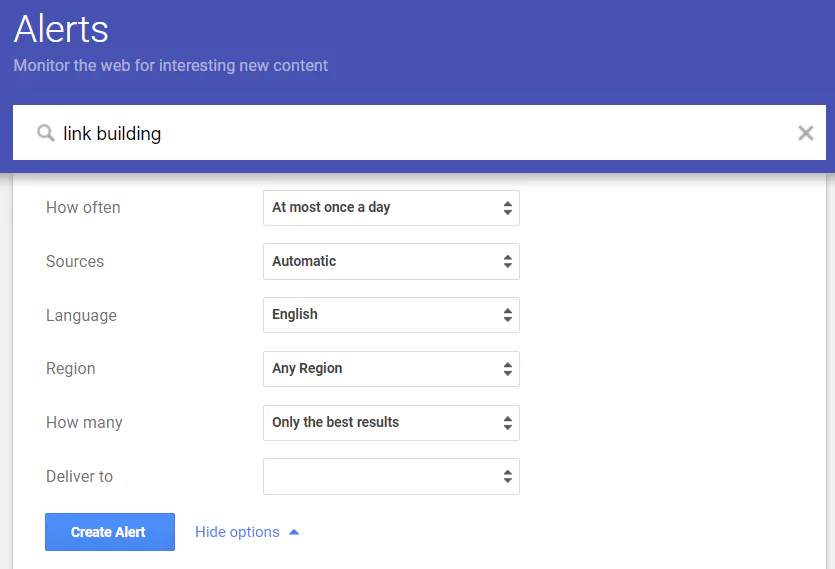
Alerts can be delivered to your RSS feed or your email. We particularly like that you can choose the sources you want to monitor, such as news, blogs, or the entire web.
The only downside is that getting these alerts nonstop gets annoying (and can clog your inbox!) fast, especially if you’re constantly getting low-value alerts.
Still, Google Alerts is a cool option if you’re just starting out or don’t want to invest in paid link-building tools.
Other Tools Worth Knowing About
We went over what we consider the best link-building tools for both pros and beginners, but there are other alternatives on the market.
Here are a few worth mentioning:
- Modash - Modash ($299/mo Essentials monthly, $199/mo annual; Performance $599/$499) is more laser-focused than typical outreach tools. Instead of helping you find websites, it helps you find Instagram, TikTok and YouTube influencers suitable for your niche.
- Link Prospector by Citation Labs - $47/mo subscription or $5/credit pay-as-you-go (with a $5 trial). Link Prospector generates pre-built query strings to find link-building opportunities. Useful if you don't want to roll your own Google Search Operators.
- Screaming Frog SEO Spider - £199/yr (~$259 USD) per-user license; free tier still capped at 500 URLs. Screaming Frog is a website crawler that helps you find broken links, identify on-site SEO issues, and prep technical audits. Different category from the other tools here - it's about your own site, not finding prospects - but worth having in the stack.
- Cold outreach platforms (for scaled link building campaigns) - If you're running outreach at high volume, dedicated cold-email tools like Lemlist ($79/user/mo Email Pro), Smartlead ($39+/mo with unlimited mailbox warm-up), or Instantly ($37+/mo with a 160M+ contact database) are more efficient than BuzzStream's outreach features. Pair with Clay (above) for prospect enrichment.
Need help? We'll handle your entire link-building campaign for you.
Getting backlinks is a strenuous process, even when you're using the best link-building tools.
Admittedly, tools can make link prospecting and outreach easier, but they can't do the actual work for you. For example, you'll still need to create and send pitches and act on your SEO reports.
Our company can help.
With over a decade of experience in link building, we can land you high-quality links relevant to your industry. Reach out today and book a consultation with our outreach specialists.