![61 SEO Keywords For Financial Advisors In 2026 [+Spreadsheet]](/images/blog/speech-bubbles.webp)

Looking for financial advisor SEO keywords you could target on your website? Look no further! We’ve compiled a list of 61 best keywords to target in 2026.
It includes a mix of informative and commercial keywords, allowing you to optimize both your blog posts and commercial pages - and to give yourself a fighting chance of being cited in the AI-generated answers that now sit above traditional results for a growing share of finance queries.
We also created a spreadsheet that will help you easily track your progress on each of these keywords. Find it below and download it for free!
Contents
How to Choose The Right Financial Advisor SEO Keywords
Before we get started, note that not all keywords on this list (or in general) will be the right fit for you.
To determine if they are, consider these top three criteria: keyword and content relevance, search volume, and keyword difficulty.
Ensure Keyword Relevance
Targeting irrelevant keywords is a waste of your time and money. These two questions will help ensure you target only the relevant ones:
- Are the keywords relevant to your offerings? For example, if you don’t advise people on getting out of student debt, you probably shouldn’t target the keyword “student loan financial advisor.”
- Are the keywords relevant to your audience? For example, if you only work with businesses, “student loan financial advisor” would again be irrelevant.
Long-tail keywords are generally more relevant because they’re longer and more specific.
As an example, consider the differences between these two keywords:
- “financial advisor”
- “when to get a financial advisor”
The second keyword is long-tail and provides helpful context around what the user is looking for. This context can help you determine its relevance.
On the other hand, the keyword “financial advisor” provides little context and is much broader. It is potentially searched for by people who are not looking for financial advisor services and, thus, wouldn’t be your target audience.
Ensure Content Relevance
Another thing to consider is content relevance. Besides choosing relevant keywords to target, you should also create content that is relevant to those keywords.
To do so, consider the intent behind a user looking up a keyword.
For example, “how to find a good financial advisor” has an informative intent, as it implies the user wants for more information rather than immediately buy services.
That’s why creating a blog post that targets this keyword is a good idea; creating a commercial page, on the other hand, is probably not.
Consider Monthly Search Volumes (MSVs)
The second thing to consider is how many users actually search for your keyword.
It doesn’t make sense to create content around keywords no one searches for.
So, to determine if a keyword is worth it, you’ll need SEO tools such as:
- Google Keyword Planner (free; very limited data)
- Semrush (paid)
- Ahrefs (paid)
Enter the keyword you want to analyze and look at a metric usually called “search volume” (SV) or “monthly search volume” (MSV).
Here’s what that looks like in Ahrefs:

The higher the search volume, the more traffic you can get on your website.
However, higher search volume usually comes with higher keyword difficulty.
Consider Keyword Difficulty (KD)
Keyword difficulty (KD) indicates how difficult it is to rank for particular SEO keywords for financial advisors.
Keywords with high KD are difficult to rank for because the competition is strong.
Different SEO tools measure KD based on different metrics. However, backlinks are probably the most commonly used factor.
So, in other words:
The higher a keyword’s difficulty, the more backlinks you’ll need to rank for it.
If you don’t have enough backlinks to your site, target keywords with lower difficulty and/or work on building new backlinks. You can outsource link building to agencies like ours.
37 Top Keywords for Financial Advisor SEO - Higher KD
Here are 37 keywords for financial advisors with high keyword difficulty:
- financial advisor
- financial advisor near me
- fiduciary financial advisor
- what does a financial advisor do
- what is a financial advisor
- how much does a financial advisor cost
- how to find a financial advisor
- personal financial advisor
- online financial advisor
- financial advisor fees
- find a financial advisor
- best financial advisor
- fee only financial advisor
- do i need a financial advisor
- certified financial advisor
- fee based financial advisor
- financial advisor definition
- how to choose a financial advisor
- financial advisor certification
- financial advisor companies
- top financial advisor firms
- robo financial advisor
- financial investment advisor
- how much is a financial advisor per hour
- financial advisor services
- how to find a good financial advisor
- how to pick a financial advisor
- best fiduciary financial advisor
- should i get a financial advisor
- questions to ask your financial advisor
- best financial advisor companies
- average financial advisor fee
- how to get a financial advisor
- famous financial advisor
- when to get a financial advisor
- what to look for in a financial advisor
- choosing a financial advisor
Ranking for these keywords will be difficult without backlinks. If you want to rank, purchase backlinks first or build them as you publish new content.
24 Top Keywords for Financial Advisor SEO - Lower KD
Below, we’ve extracted an additional 24 keywords with a slightly lower keyword difficulty:
- free financial advisor
- financial advisor cost
- independent financial advisor
- how much is a financial advisor
- retirement financial advisor
- questions to ask a financial advisor
- fiduciary financial advisor near me
- financial planner vs advisor
- financial advisor vs financial planner
- worst financial advisor companies
- is a financial advisor worth it
- small business financial advisor
- what is a fiduciary financial advisor
- fiduciary vs financial advisor
- business financial advisor
- financial advisor for debt
- financial advisor for low income
- student loan financial advisor
- questions to ask financial advisor in first meeting
- wealth manager vs financial advisor
- divorce financial advisor
- how does a financial advisor get paid
- financial advisor vs accountant
- financial advisor for young adults
Ranking for these keywords will be easier than ranking for the keywords listed above.
Want to have all of these keywords in one place + easily track your progress? You can use the spreadsheet we created for you. Access it here and make a copy for free.
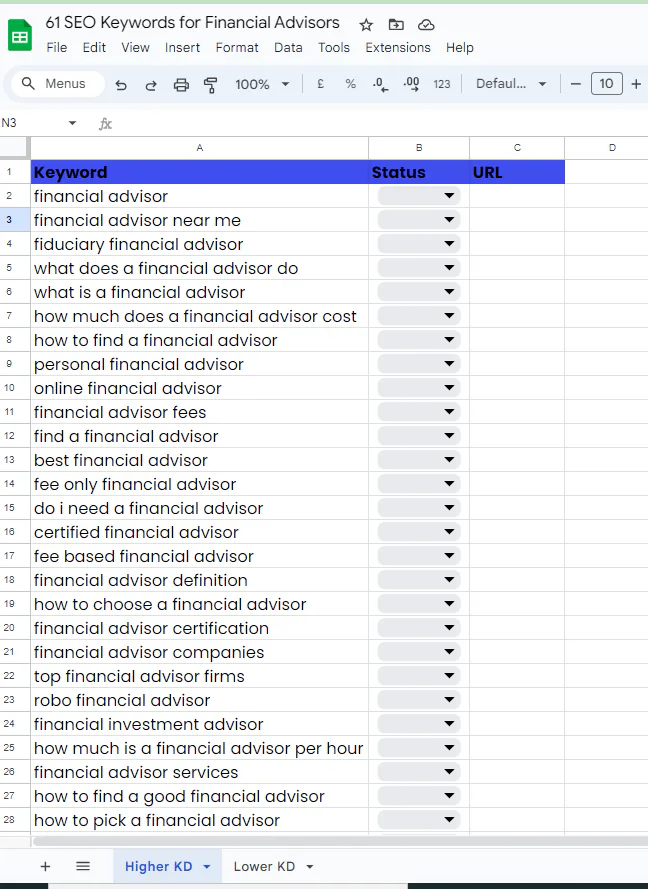
Insights On Financial Advisor SEO Keywords
Based on the above SEO keywords for financial advisors, we can conclude that users:
- Search for specialized financial advisors (“student loan financial advisor,” “divorce financial advisor,” “business financial advisor”);
- Are highly interested in the cost of financial advisors (“how much is a financial advisor per hour,” “financial advisor cost”);
- Aren’t sure how financial advisor services differ from similar services (“financial advisor vs financial planner,” “financial advisor vs accountant”);
- Have a lot of basic questions about the services (“how does a financial advisor get paid,” “questions to ask your financial advisor,” “when to get a financial advisor”).
You can get more insights about your target audience by researching your competitors’ content on these keywords.
How to Leverage Keywords for Financial Advisors
By now, you hopefully have a list of financial advisor SEO keywords you want to target. But how do you actually rank for them?
Here’s a quick step-by-step guide:
1. Optimize Your New Content
The best way to rank for new keywords is to create new content that targets them. Here a few content optimization tips to get you started:
- Add your main target keyword to your H1 heading.
- Add variations of your target KW to other headings.
- Use the main target keyword in the first and last ~100 words of your content.
- Use the KW in your URL.
- Add images to your content and write descriptive alt text (that preferably contains your KWs as well).
To further improve your results, consider hiring a professional content writer.
2. Create Smart Anchor Phrases
Building backlinks to your new content will help it rank faster and higher.
As you do so, make sure that the anchor phrases of your backlinks contain your main KW or its variation.
For example, we used “image SEO” as an anchor phrase for a link to a page specifically on image SEO:
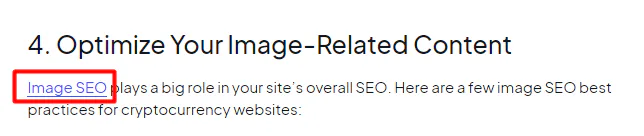
This makes the anchor phrase highly relevant to the page we’re linking to.
3. Optimize Your Old Content
If you already published content on your website without previously optimizing it for specific keywords, now’s the time to do it.
Check out the tips we gave in point #1 on this list to boost your optimization efforts.
4. Analyze Competitors
SEO tools (like Ahrefs, Semrush, or Moz Pro) can help you identify the keywords your competitors are currently ranking for, allowing you to write content that outranks them.
5. Find Relevant Link Building Opportunities
You can also use the tools we mentioned above to check your competitors’ backlinks and anchor phrases.
Sites that link to your competitors have already shown interest in your niche - so they will likely want to link to you, too.
Many of these sites will likely also be relevant to your niche, so getting links from them will lead to faster results and more authority in the financial space.
With that in mind, consider reaching out to them and asking for a backlink.
Other link building opportunities can include:
- Unlinked brand mentions
- Unlinked image credits
- Listings in financial advisor directories, etc.
6. Track Your Rankings and Traffic
Finally, don’t forget to measure the results you get from investing in SEO keywords.
Track if your rankings and traffic improve by using tools such as Google Search Console, Google Analytics, or Bing Webmaster Tools.
Tools like Ahrefs and Semrush can also estimate your positions and traffic, but they’re slightly less reliable than native tools.

Need Help With Off-Page SEO? Let’s Talk.
No matter how good your content is, you’ll likely need backlinks to rank. We can help you build them.
You can order high-quality backlinks immediately from our site or contact us for more information. We offer lifetime guarantees on all our backlinks and can build them on authority sites, like Yahoo Finance, Forbes, and CryptoGazette.
FAQs
How do I prioritize SEO keywords?
You should prioritize SEO keywords by relevancy, attainability, and how much they’ll pay off. That means taking into account (1) user intent, (2) keyword difficulty, and (3) search volume.
If your goal is to sell your financial advisor services, start by choosing keywords with high commercial intent and an adequate search volume. Additionally, if your site doesn’t have a strong backlink profile, consider using keywords with lower difficulty.
On the other hand, if your goal is to increase brand awareness or just get more traffic on your site, you may want to target keywords that are more informative.
What are seed keywords for SEO?
Seed keywords are the keywords you use as your starting point for finding relevant keyword suggestions. For example, using “financial advisor” as your seed keyword can help you find related keyphrases, such as “what is a financial advisor.”
How do I find competitors’ SEO keywords?
To find competitors’ SEO keywords, you’ll need SEO tools like Semrush, Ahrefs, or Moz Pro. You’ll usually just need to enter your competitors’ URLs and the tools will automatically find the keywords they rank for.
Alternatively, you can also try analyzing which keywords your competitors are targeting manually by looking at their sites. For example, you could check which keywords they’ve added to their URLs:

If they’re doing SEO for financial advisors right, they’ll have their target keywords there. Note, however, that this doesn’t mean they’re actually ranking for these keywords.