
To build links, you need to invest money or time. AI tools like ChatGPT and Claude can compress the time side dramatically - but only if you use them well. Used badly, they get your pitches ignored and your outreach domain marked as spam.
This guide was last refreshed in May 2026. A lot has changed since the original 2023 version: ChatGPT has gone through five major model upgrades (we're on GPT-5.5 as of April 2026), Claude and Gemini have caught up to or in some areas surpassed ChatGPT, AI Overviews have reshaped how people interact with search results, and the playbook for using AI in outreach has matured significantly.
Below: how to use ChatGPT - and the other AI assistants worth knowing in 2026 - for link building, with an honest take on where AI helps and where it backfires.
Contents
- Which AI Assistant Should You Use in 2026?
- How to Use ChatGPT
- AI Overviews, GEO, and What Link Building Looks Like in 2026
- What Are the Benefits of Using ChatGPT for Link Building?
- 13+ Ways to Use ChatGPT to Build Backlinks
- The Risks of AI for Link Building in 2026
- Need Humans To Build Your Backlinks? Let’s Talk.
- Frequently Asked Questions
Which AI Assistant Should You Use in 2026?
"ChatGPT or nothing" stopped being a serious question in 2024. By 2026, four major assistants are credible for link building work, and most serious operators use at least two side by side. Quick read on the landscape:
- ChatGPT (OpenAI) - Default consumer model is GPT-5.5 (released April 2026). Free tier ($0, capped at ~10 messages/5 hours, ad-supported in the US); Go $8/mo (ad-supported); Plus $20/mo (the workhorse tier - includes Deep Research, Sora, Codex, Agent Mode, and the current default model); Pro $100/mo (added April 2026); Pro $200/mo (20× Plus usage limits, 250 Deep Research runs/mo, ~1M-token context). Plus is still the best price-to-capability ratio for most link builders.
- Claude (Anthropic) - Flagship is Claude Opus 4.7 (April 2026), with Sonnet 4.6 as the everyday workhorse and Haiku 4.5 as the cheap fast model. All run with a 1M-token context window. Subscriptions: Pro $20, Max 5× $100, Max 20× $200. Claude tends to outperform ChatGPT on long-form writing and nuanced reasoning; ChatGPT remains stronger for general research with the web + images.
- Gemini (Google) - Flagship is Gemini 3.1 Pro (February 2026) with a 2M-token context window. Google AI Pro $19.99/mo covers most needs; Google AI Ultra (~$125/quarter) adds Veo 3.1 video, 25K monthly AI credits, and YouTube Premium. Gemini's tight integration with Google Search and YouTube makes it useful for AI-Overview-aware research.
- Perplexity - Best-in-class citation-driven research. Pro $20/mo for unlimited Pro Search; Max $200/mo adds the Comet browser and Claude Opus + o3-pro access for Deep Research runs. Every claim comes with sources you can verify and pitch from - uniquely useful for link builders.
For the rest of this guide we'll talk in terms of "ChatGPT" because the workflows are largely interchangeable across assistants. Anywhere we mention a specific feature (Deep Research, Agent Mode, Computer Use, Custom GPTs), we'll flag which assistant offers it.
One important correction from the 2023 version of this guide: creating a Custom GPT now requires a paid ChatGPT plan ($20+/mo). Free users can use Custom GPTs but can no longer build them. The original 2023 claim that custom GPTs were available on the free tier is no longer accurate.
For link building, the case for a paid tier is strong: Deep Research, Agent Mode / Computer Use (agentic outreach automation), higher file-upload limits, advanced data analysis on CSVs, voice input, and full access to the latest models all live behind paid tiers. $20/mo against the time savings is an easy call.
How to Use ChatGPT
Using basic ChatGPT functionalities is extremely simple. All you have to do is go to chatgpt.com, log in, and start typing in your prompts. The process is similar to interacting with chatbots on commercial websites.
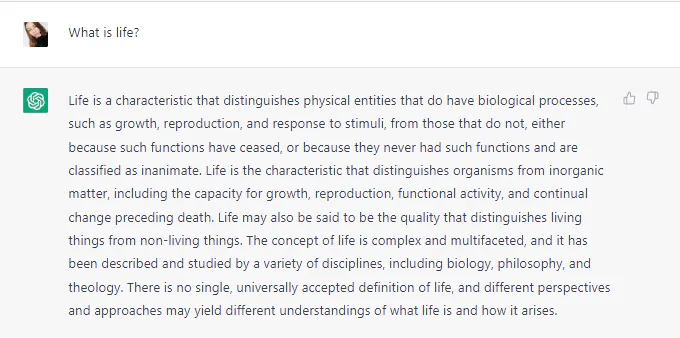
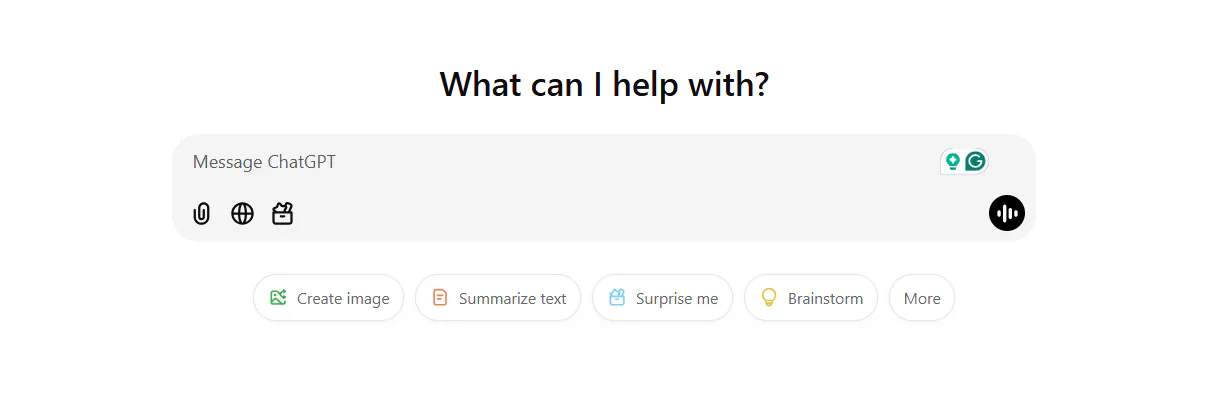
Other features to leverage include, as mentioned, uploading files and recording voice prompts. You can now also search the web with both paid and free versions of ChatGPT.
You can access these features right from the chat box:
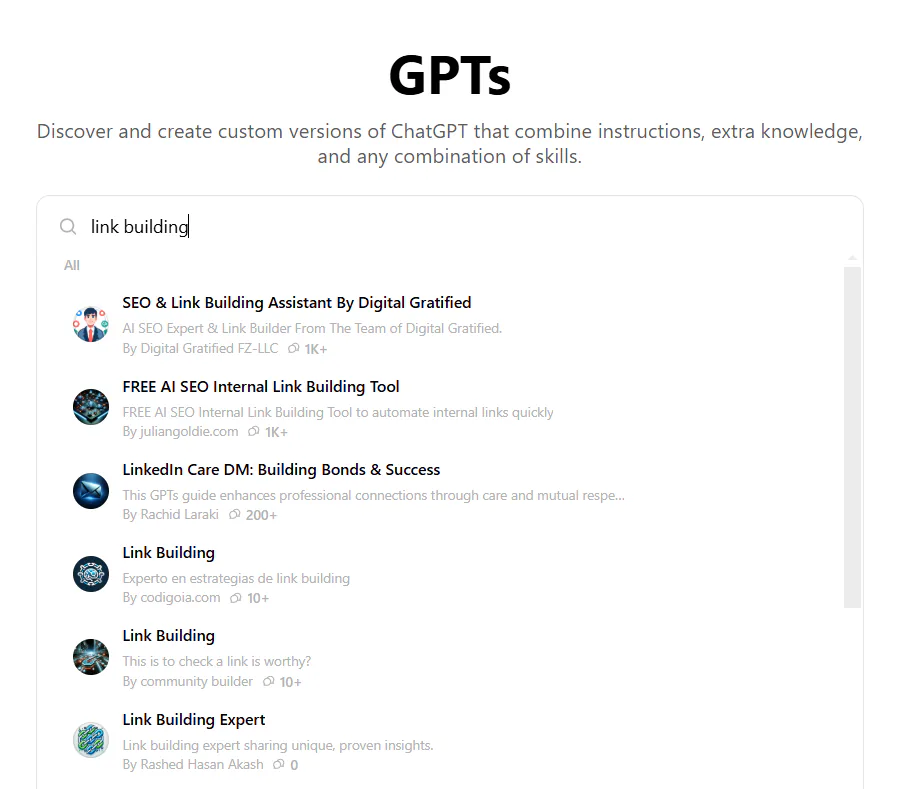
Additionally, you can click "Explore GPTs" in the menu on the right and find GPTs custom-built for link building. You can add these GPTs to your dashboard for free and leverage their (supposedly) more advanced capabilities. These GPTs have been specifically trained for link building purposes.
AI Overviews, GEO, and What Link Building Looks Like in 2026
Before the use-cases, one shift that's good news for link builders: AI Overviews and tools like ChatGPT, Perplexity, and Gemini now answer a large share of search queries directly - and they do it by citing authoritative sources. Which sources get cited? The ones with strong editorial backlink profiles. Link building has gone from feeding one ranking system (Google) to feeding several at once, and high-quality citations are now more valuable than ever.
What this means in practice:
- Backlinks now feed two ranking systems, not one. Editorial mentions used to influence Google rankings. They now also feed the grounding sources that ChatGPT, Perplexity, Gemini, and Google AI Overviews cite when answering questions. A single high-quality citation in a respected outlet can pay you traffic, brand visibility, and AI-citation visibility for years.
- "Generative Engine Optimization" (GEO) is now a recognized discipline. The overlap between Google's organic top-10 and the sources AI engines cite has dropped from around 70% to under 20% - meaning a different set of pages get cited in AI answers than rank on the SERP. Both sets are worth targeting; some pages should be linked-from for SEO, others for AI citation.
- Practical content tweaks that help AI citation: lead with direct answers in the first 200 words, use question-form H2s, include specific verifiable data points with sources, build topical clusters around the same theme, use FAQ/HowTo schema, and show a visible "Last Updated" date on every article.
You'll see this pattern in the use-cases below: AI helps you build more links faster, and AI search is increasingly the system rewarding those links.
What Are the Benefits of Using ChatGPT for Link Building?
Using ChatGPT for link building can help you:
- Speed up the process: Finding relevant keywords and link building opportunities is a time-consuming process. You can cut it in half by giving ChatGPT appropriate prompts. The AI will generate a list of suitable “candidates” more quickly than you could do manually.
- Reduce costs: ChatGPT can also save you the money you’d probably spend on content creation or hiring professional link builders. That’s not to say you don’t need humans to supervise and rate ChatGPT’s outputs – you do. Still, ChatGPT can skyrocket your team’s productivity and save you dollars in the long run.
- Generate ideas: ChatGPT can act as your brainstorming buddy and help you develop new blog post ideas, creative keywords, or ways to paraphrase clumsy sentences. No more feeling stuck!
13+ Ways to Use ChatGPT to Build Backlinks
ChatGPT can streamline your link building process, from finding relevant websites to relationship-building and content generation. What it can't do is actually build links for you.
You'll still need to do the outreach yourself, create content, and choose the most suitable anchor phrases. If you need help with that, reach out to our team for help.
With that said, we'll give you 13+ ideas on how to speed up various parts of the process using ChatGPT, but know that the list doesn't end here. You can always find new ways to leverage the power of ChatGPT and make your link building process more efficient.
1) Ask ChatGPT to create a list of target websites
First, ask ChatGPT to find websites that would be a good fit for you. To do so, we recommend giving it some context on your business and what you're looking for, as well as clear instructions on what the final output should look like.
Turn on the Search the Web feature for best results.
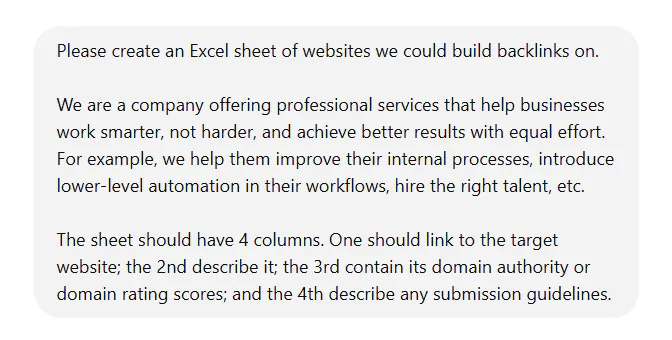
Keep in mind that ChatGPT doesn't have access to tools like Ahrefs and can't actually check domain authority (DA) or domain rating (DR) scores. Even so, we found it to be surprisingly close.
Here is what the output looks like:
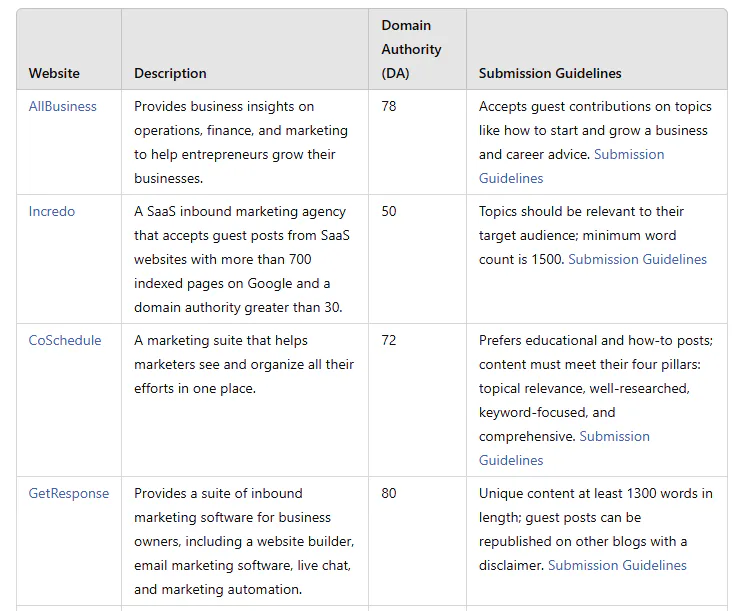
We should now do some manual analysis to confirm that the websites on this list are truly a good fit. This can include double-checking the topics, DR and DA scores, and submission guidelines.
2) Upload the sheet and generate personalized suggestions
Once you have the final list of target websites ready, you can upload it back to ChatGPT and ask it to, for example, generate personalized outreach emails for every website.
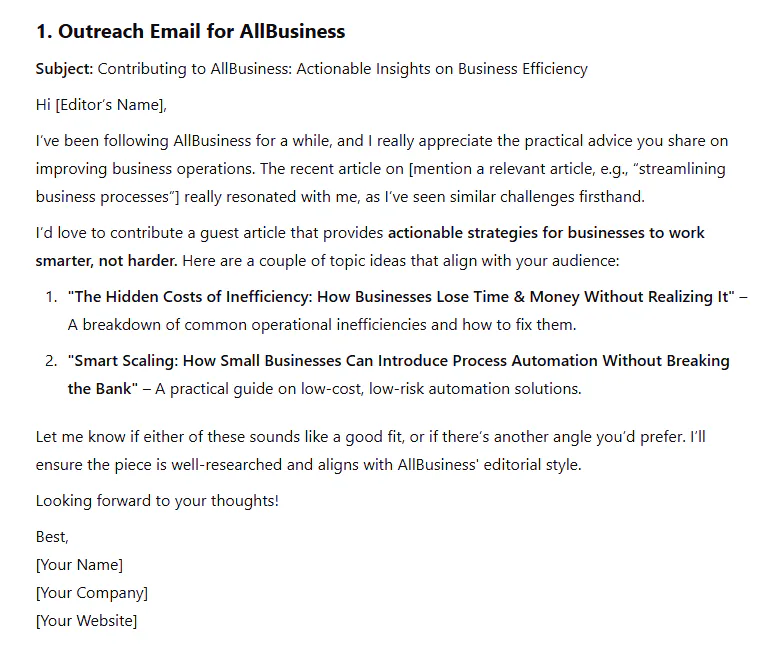
Besides helping you establish initial contact, the AI tool can also help you with longer-term relationship building. If you have existing email templates, you can also upload those and ensure that ChatGPT follows a high-quality structure.
Additionally, you can ask it to create guest post suggestions for every website, or write entire posts autonomously.
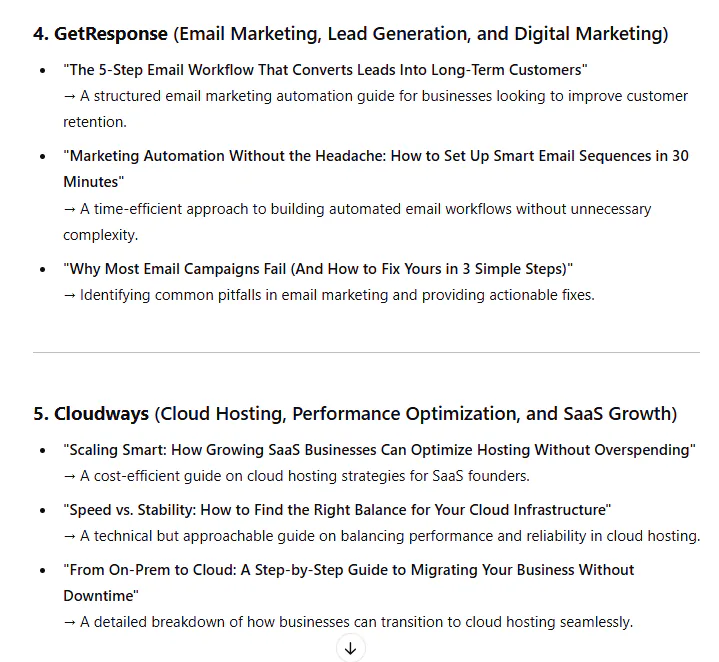
Overall, this strategy is particularly useful when time is of the essence. For example, as one user demonstrated, you can use ChatGPT to be the first to answer HARO queries:
(HARO has since changed hands - Cision wound it down in 2024 and Featured.com relaunched it in April 2025. See our updated HARO guide. The same approach works with any media outreach platform.)
3) Generate more content ideas
You can also use ChatGPT to generate personalized-to-you content ideas based on the keywords you're trying to rank for rather than the websites you're trying to write for.
Start by uploading a target keyword list. Then, leverage ChatGPT to generate post ideas that allow you to naturally weave in your target keywords as anchor phrases and link to the pages you've optimized for these keywords.
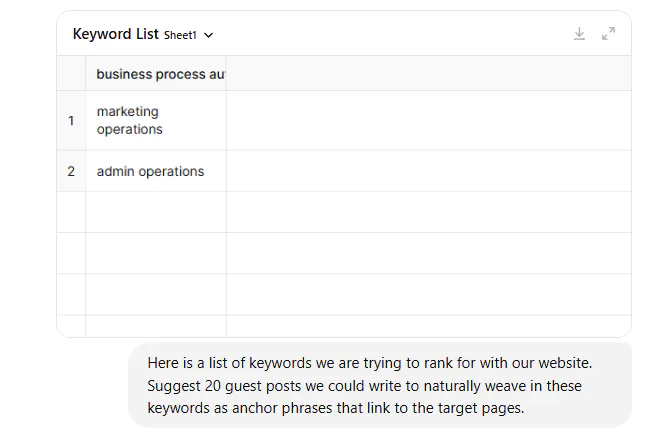
Here is the response we got:
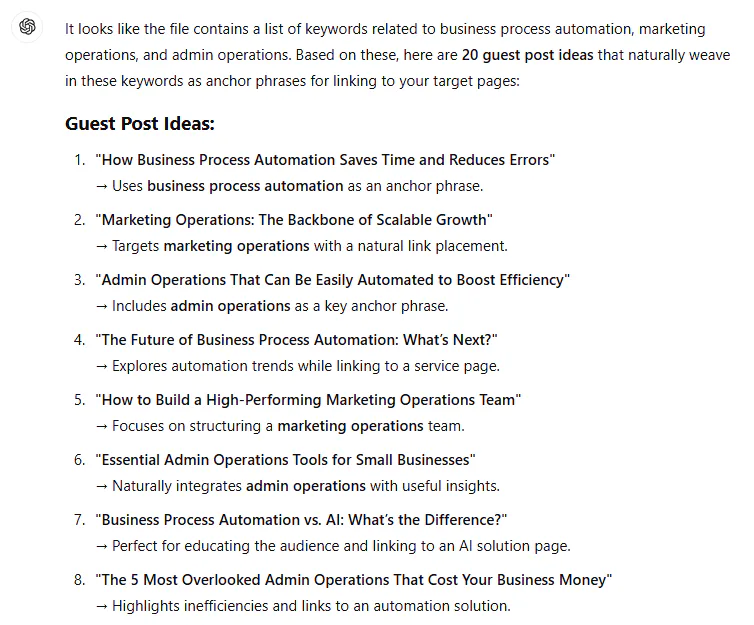
You can also ask ChatGPT to provide link magnet ideas, or suggest content that could naturally attract backlinks. Typically, ChatGPT provides pretty solid ideas, especially when given enough context.
4) Generate keyword ideas
On the flip side, you may not know what topic to cover in a piece of content or which keywords to target. ChatGPT can help you come up with some truly outstanding ideas and speed up brainstorming.
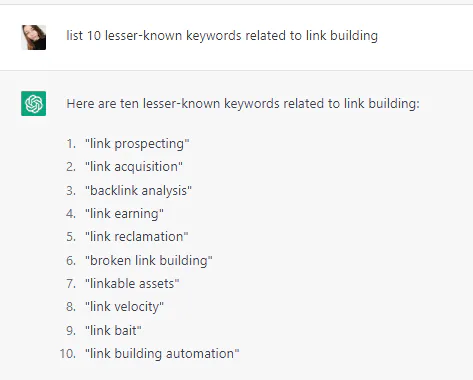
Of course, you should still run all the proposed keywords through specialized SEO tools.
ChatGPT has no idea if the keywords it suggests have adequate search volumes or if you could realistically rank for them. So, you’ll still have to do the actual keyword research part on your own.
Even so, ChatGPT can give you a great starting point.
5) Find relevant influencers
Partnering with influencers in your niche is one of the fastest ways to build links. Finding them, on the other hand, can be a time-heavy process. ChatGPT can assist you here, too.
Besides generating a list of relevant influencers, ChatGPT can also ensure they fit your specific criteria. For example, if you can’t afford to work with the biggest influencers in your industry, you can simply instruct ChatGPT to find relevant micro-influencers:
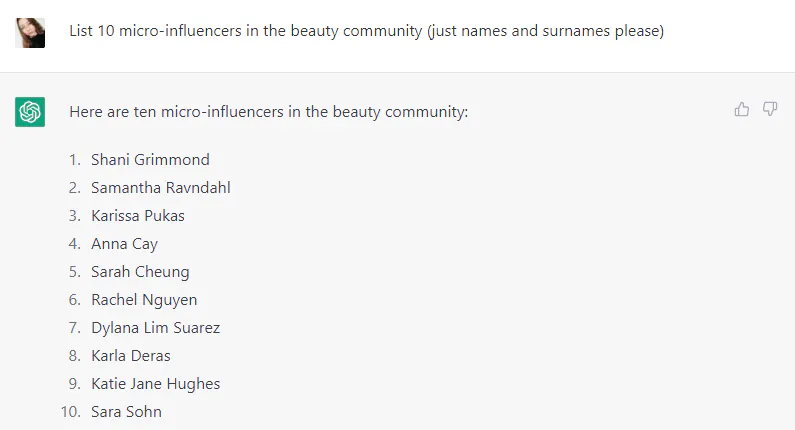
You can also add other criteria. Your prompts – and your results – will come down to your requirements and creativity.
6) Find relevant online communities
Forum link building is one of the lesser-used link building strategies, primarily because it results in nofollow backlinks that don't have as much influence as dofollow ones. Still, considering that you can secure backlinks there for free, we personally wouldn't ignore it.
Plus, joining industry-relevant online communities allows you to connect with your target audience, (subtly) promote your business, and build thought leadership.
You can find relevant communities faster using AI.
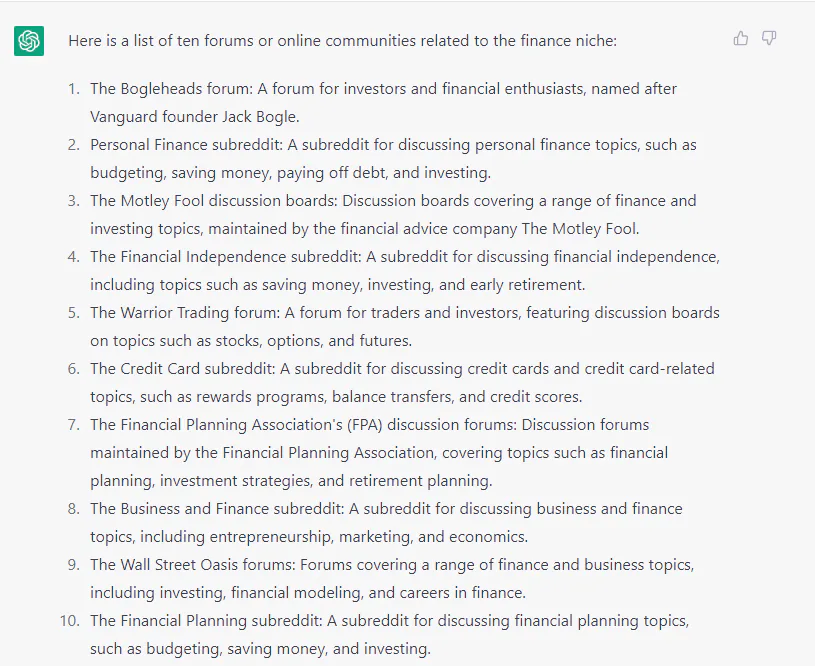
Again, check every suggestion manually to confirm that it’s truly suitable for you and your niche. If so, you can start submitting content, commenting on other people’s posts, and building new links to your site.
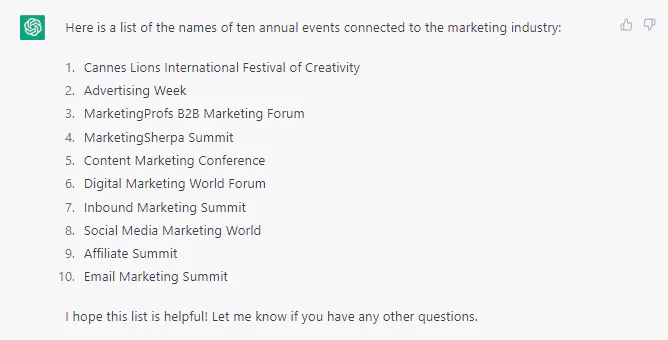
7) Find industry events
Speaking at industry events and conferences can often earn you some juicy backlinks from high-authority sites. The problem? Finding such events is often tricky, especially if you're not sure where to look.
AI can help you with that, too. Simply prompt ChatGPT to create a list of upcoming or annual events related to your industry:
8) Find relevant podcasts
Getting featured on podcasts can immediately up your credibility, but it won’t always earn you backlinks. Many podcast hosts don’t publish the episodes on their website nor link back to their guests.
So, you need to find podcasts that fit these very specific requirements, and a simple Google search won’t cut it.
ChatGPT, on the other hand, can easily find websites that fit all your criteria. Just make sure you include them in your prompts and enable searching the web.
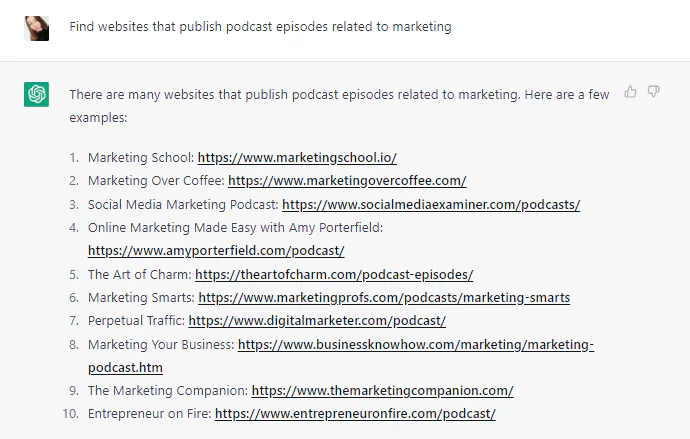
As we’ve mentioned, ChatGPT’s suggestions may not always be accurate, so always double-check them.
9) Create content quickly
Creating content is one of the key aspects of link building. And whether you need to create guest posts, provide expert commentary, or submit niche edits, ChatGPT can help. In fact, this is where link building with ChatGPT becomes especially creative. You can experiment with many different prompts and approaches.
One of our favorite strategies is telling ChatGPT to pretend it is an expert in a particular field.
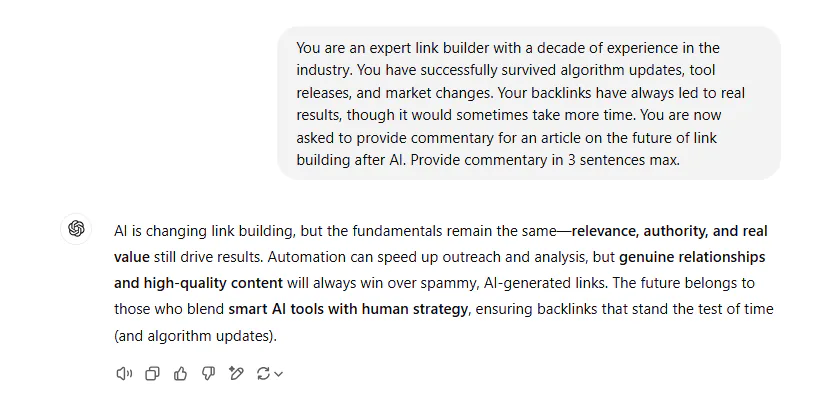
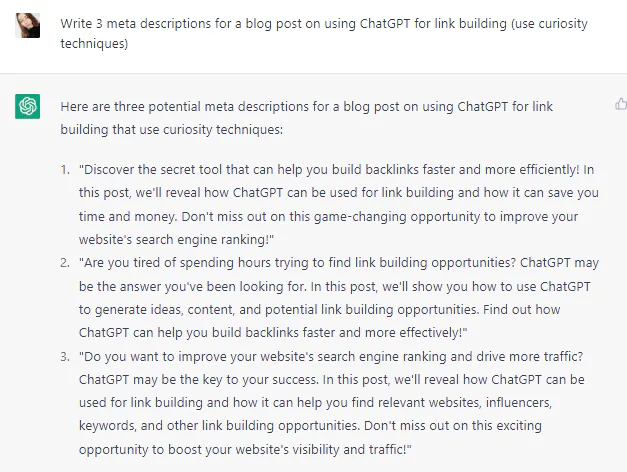
You can use ChatGPT for far more than just blog posts. Besides being able to write other forms of content, it can also generate titles, meta descriptions, meta tags, and everything else you’ll need to get your content to rank and convert.
10) Competitor analysis
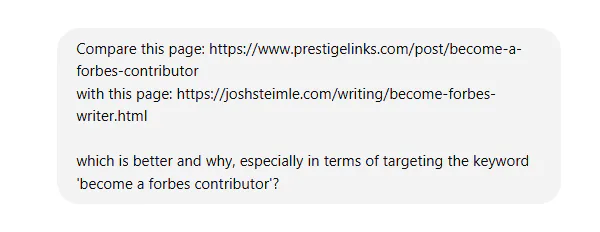
Competitor analysis should be a key part of your link building efforts, and you can use ChatGPT to streamline it in various ways. One way to leverage it is to quickly compare your existing content against your competitors':
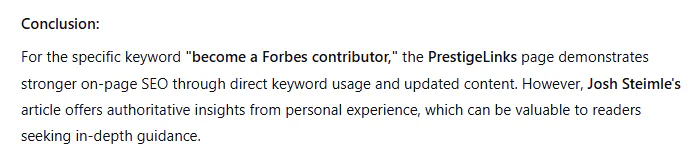
ChatGPT can actually provide some terrific insights:
You can also upload CSV files with key competitor metrics and compare them against yours in a fraction of the time. For example, ChatGPT can assist in identifying link building opportunities by pinpointing the sites that link to your competitors, but not to you.
11) Broken link building
Broken link building is one of the most efficient, but also time-consuming link-building strategies. Though ChatGPT can’t replace broken links with yours for you, it can help you find sites to monitor for broken links.
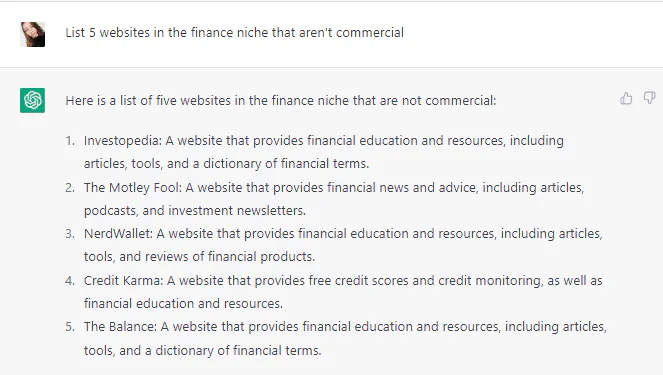
Once you find these sites with ChatGPT, you want to scour them for broken links. If you find them, reach out to the site owners to have them replaced with yours. And don’t forget to use ChatGPT to write those outreach emails, too.
12) Draft expert source pitches
Once you've found a relevant HARO / Featured.com query (or a journalist's direct request), ChatGPT is useful for turning your raw, off-the-cuff expertise into a tight, quotable response. Paste the journalist's question, paste your bullet-point answer, and have the model tighten it into 150 - 200 words with a usable pull-quote.
The model is good at structure and concision; it's bad at expertise. So the inputs matter: your bullets need to contain the actual insight, then ChatGPT shapes them into the form a reporter can lift verbatim. Reporters get hundreds of bloated, AI-padded responses a day - a tight, specific one stands out.
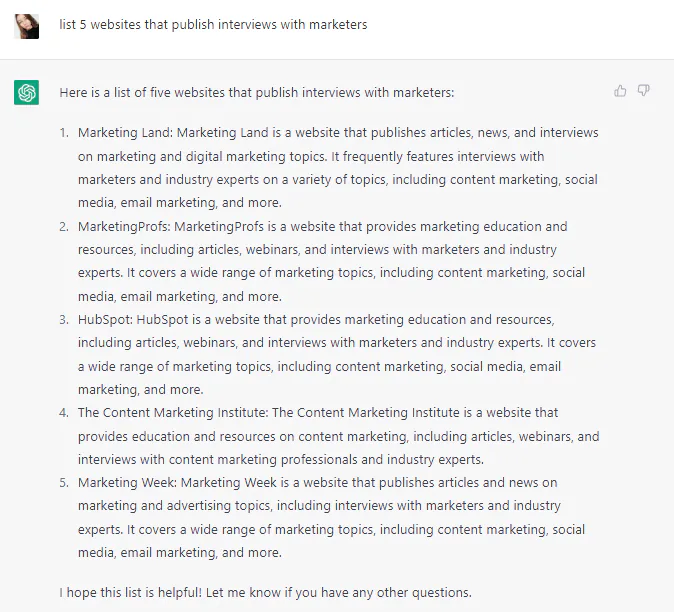
13) Identify interview opportunities
Getting your interview published on high-authority websites can immediately bump you up in search engines. Find appropriate sites using ChatGPT and pitch yourself as an interviewee to website owners from there.
14) And More
The list doesn’t end here. There are many more ways to use ChatGPT to build links. Your results will come down to two things: your knowledge of SEO and link building and your creativity.
If you know a lot about SEO and link building, you’ll be able to come up with more prompts and more ways to use ChatGPT. And the more creative you get with your prompts, the better results you’ll get.
Still, you want to be careful about how you use ChatGPT. There are some limitations – and possible penalties – you should be aware of before blindly copying and pasting its outputs.
The Risks of AI for Link Building in 2026
Used badly, AI is genuinely dangerous for link building. Here's what to actually watch for:
- Hallucinations are still real. Every assistant still confabulates facts that sound plausible. The 2026-era best practice is to use Perplexity or ChatGPT's Deep Research for anything where the claims will be published - both surface their sources so you can verify before quoting.
- AI can't replace expertise - it amplifies it (or its absence). An expert using AI produces better content faster. A non-expert using AI produces confidently-wrong content faster. Pretty much every penalty case below traces back to this.
- "Scaled content abuse" is now an explicit Google policy. Updated as part of the March 2024 core + spam updates, Google's policy distinguishes between (a) AI-assisted content that's reviewed, edited, and adds genuine value (fine) and (b) mass-produced, unedited AI content designed to manipulate search rankings (penalized). Enforcement got teeth in 2025–2026: June 2025 manual actions moved from ranking demotions to full deindexing; the February 2026 core update hammered mass-AI sites with 40–60% traffic losses; the March 2026 core update took out sites with hundreds-to-thousands of unedited AI pages, with drops of 50–80%. Ahrefs' analysis of 600K pages found near-zero correlation between AI content share and ranking position - meaning Google isn't penalizing AI per se, but it is penalizing undifferentiated, mass-produced AI.
- Site-level case studies worth knowing: HouseFresh (independent reviewer hit by 2024 updates, which prompted Google's site-reputation-abuse policy); Sports Illustrated and USA Today (caught publishing AI articles under fake author bylines, content deleted after the Futurism exposé); CNET (forced into major corrections after publishing AI personal-finance content with errors). All three are warnings about what happens when AI content ships without real editorial control.
- The "site reputation abuse" / parasite-SEO crackdown (November 2024). Google's policy update obliterated the model of slapping AI affiliate content on a high-authority parent domain. Forbes Advisor lost roughly 43% of its traffic, Time Stamped lost 97%, WSJ Buy Side lost 77%. If your link building strategy includes getting placed on host domains running this model, those placements are losing value fast.
- Regulatory pressure is rising in 2026. The EU AI Act's Article 50 disclosure obligations take effect August 2, 2026 - providers must emit machine-readable provenance (C2PA) for AI-generated images, audio, and video. California's SB 942 took effect January 2026 requiring latent provenance markers. The FTC has been more permissive under the current administration but deception cases remain enforceable.
- Bloggers and journalists actively filter AI pitches. The pitch response rate has fallen to about 3.4% as inboxes flood with AI-blasted outreach. Lazy AI pitches now hurt more than they help - they get filed, flagged, and sometimes get your sender domain reputation-tanked. The 2026 norm is "AI for research, drafting, and prioritization; humans for value, voice, and verification."
The settled view among link-building practitioners in 2026 (Aleyda Solis, Lily Ray, Glen Allsopp, and similar) is roughly: AI-assisted outreach can be ~3× faster and ~60% cheaper per link, but only when it augments a relationship-first workflow. Pure AI-blasted outreach is detectable, ignored, and increasingly punished by spam filters.
Need Humans To Build Your Backlinks? Let’s Talk.
Considering the many limitations of ChatGPT, it’s clear that you still need human experts to help you throughout the process. After tool, ChatGPT can't actually build links.
Our team of link building experts can do it for you. Schedule your free consultation today to find out how we can help you build links on high-authority websites - and why we’re able to offer a lifetime guarantee on all your placements. And if you already know what you're looking for, order your backlinks now.
Frequently Asked Questions
Can ChatGPT generate backlinks on its own?
At the moment, no, ChatGPT can't generate backlinks on its own.
Can ChatGPT use links?
Yes, ChatGPT can use links in terms of opening and visiting them. Additionally, ChatGPT can also offer links in its outputs.
Can ChatGPT search a website?
Yes, ChatGPT can search the entire web, including individual websites.
How has link building changed with the rise of AI and machine learning?
Three big shifts since 2023:
- Outreach automation got powerful - and dangerous. AI can now research prospects, draft personalized openers, and run multi-step sequences. ChatGPT's Agent Mode (August 2025) and Claude's Computer Use (March 2026) can even fill out forms and send emails in a browser. But pitches that are obviously AI-generated get filtered out at unprecedented rates; the response rate floor is roughly 3.4% for cold pitches and dropping.
- AI search changed where you want to be cited. Backlinks now feed two ranking systems - traditional Google search and AI engines (ChatGPT, Perplexity, Gemini, Google AI Overviews). The 2026 winning play is to target sources that score for both.
- Google split AI content into "good" and "bad." The March 2024 "scaled content abuse" policy and the 2025–2026 enforcement waves made it clear: AI-assisted content with real editorial value is fine; mass-produced AI content designed to manipulate search rankings is not.
Can ChatGPT browse the web or run multi-step tasks for me?
Yes. ChatGPT Plus (and higher) includes:
- Web search (live results, no extension needed)
- Deep Research - runs a multi-step research task across many sources and returns a long-form report with citations. Available on Plus ($20/mo) with a usage cap; uncapped on Pro tiers.
- Agent Mode (launched August 2025) - runs in a virtual machine with browser + terminal access, can fill forms, log into sites (in "Takeover Mode"), and send emails. Tasks typically run 5–30 minutes. Available on Plus, Pro, Business, and Team.
Claude has an equivalent capability called Computer Use, which became a production feature in March 2026 for Pro and Max users (currently macOS only, accessed through Claude Cowork or Claude Code). It supports a "Dispatch" feature that lets you delegate tasks from your phone to your Mac.
For link building, these are useful for: gathering prospect data at scale, filling out submission forms (e.g., for resource-page outreach or directory submissions), and automating the routine parts of follow-up. They are not useful for shipping unreviewed outreach - see the risks section above.